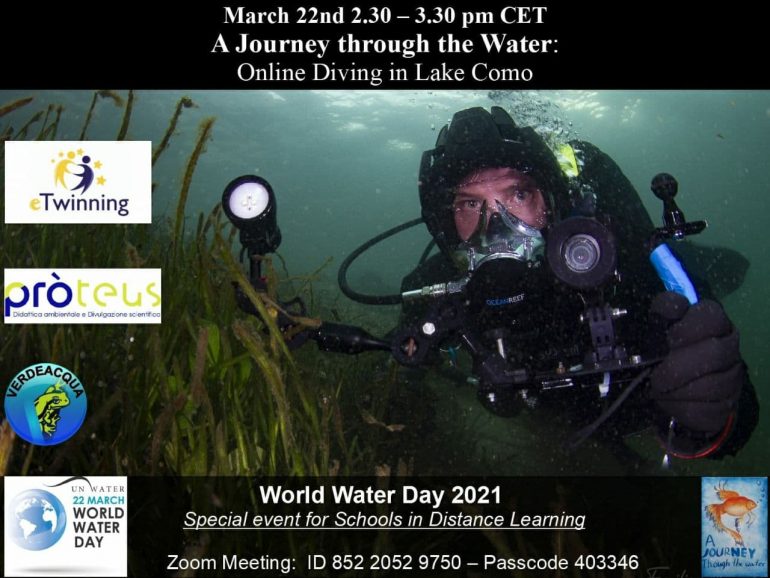
A journey through the Water: Online Diving in Lake Como


Since 2015, the UNESCO-Japan Prize on Education for sustainable development recognizes the role of education in connecting the different dimensions of sustainable development.
The Prize honours outstanding projects by institutions and organizations related to Education for Sustainable Development.
The 2021 call for nominations is open until 30 April 2021. All the information about the selection criteria, the nomination process, Prize Statutes and the International Jury are available on UNESCO website.
To know more about the Prize, read here.
PAJEP, the Center for the conservation of archives of youth and popular education associations, organizes a call for paper. On 30th and 31th March 2022 the conference on History and archives of nature animation and environmental education in France in the years 1970 -1990 will take place. This event will bring together several partners and environmental education networks.
The event is conceived as the culmination of a study cycle on the theme of the history of nature-environment animation in those years. It aims to open up new avenues, to identify researchers in this field and to attempt a first synthesis of elements collected since 2016 within the framework of 6 preparatory study days.
The colloquium will bring together archivists, researchers and actors (activists and representatives of associations); this call for paper is therefore addressed to all of these networks. The organizers expect contributions from sociology, anthropology, environmental sciences, science and technology of physical and sports activities, etc.
You have time until 19th April 2021 to submit your paper
For further information about how to submit a paper and on the conference, click here

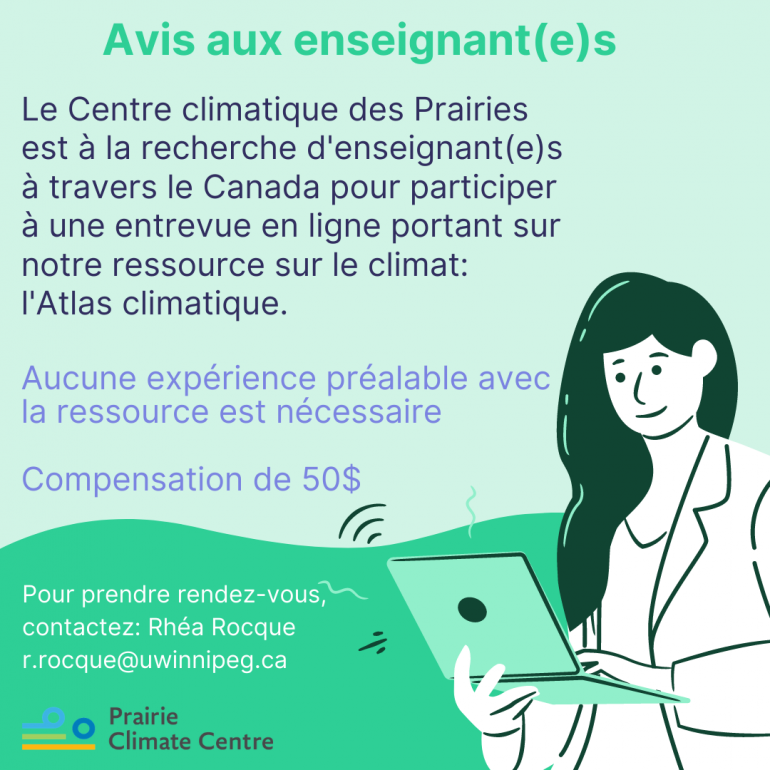
The Prairie Climate Center is looking for teachers from all over Canada and who teaches every age group to do an online interview about their online resource, Climate Atlas of Canada.
The interview will last about 1 hour. No previous experience with Climate Atlas of Canada is required. You will be asked about the browsing experience on their site to give a feedback in real time.
You can find all the details in the image below.


The Ocean is key to our life. It regulates the climate system, it produces more than 70% of the oxygen we breathe thanks to sea plants and provides us food. For these reasons, it’s very important to get to know it better in order to protect it and to manage it in a more sustainable way.
A company from San Francisco, SOFAR Ocean has a clear mission: “We connect the world’s oceans to provide insights to science, society, and industry for a more sustainable planet”.
The main goal of the company is to create data-abundant ocean to raise awareness of the risks connected to climate change, to generate a better understanding of the ocean environment and contribute to a more sustainable planet. They developed a real-time ocean weather sensor network, inspired to the way marine mammals communicate, which is able to provide data, information and forecasts about marine weather .
According to A. Reynard, writer of the article “Mitigating Climate Change: It Starts With Better Ocean Data”, better ocean data are fundamental. The ocean has a key role in mitigating the effects of human emissions, but now this is resulting in rising sea levels, acidification and extreme weather events.
To mitigate these effects and reduce our carbon footprint we need more affordable and open data and a unified approach.
Read here the full article.

The UNESCO World Conference on Education for Sustainable Development (17-19 May 2021) is organized by UNESCO in cooperation with and supported by the Federal Ministry of Education and Research of Germany, and with the German Commission for UNESCO as advisory partner.
This year the Conference wants to address the challenges the climate crisis and Covid-19 brought to the attention and equip learners with knowledge, skills, values and attitudes needed to contribute to a more sustainable world. In 2017, ESD (Education for Sustainable Development) was recognized by UN General Assembly as an integral element of the SDGs on quality education and a key enabler of all the other SDGs.
The goal of the Conference is to create a momentum for the new framework ESD for 2030 (that focuses on streamlining ESD with Agenda 2030) to achieve the SDGs within the next 10 years and to build education systems that support learners of all ages to be responsible and active contributors to more sustainable societies and a healthy planet.
The Conference will take place on a participatory online platform. The format of the virtual Conference will include interactive plenaries for debate and dialogue and concurrent sessions for in-depth discussion, online-workshops, virtual exhibitions and digital networking opportunities. Interaction will be key to the whole programme in order to provide a learning experience for all.
Further information on participation and how to register for the Conference will be soon available on UNESCO website.
In preparation of the UNESCO World Conference on ESD, you can participate to the pre-conference workshops to April 2021.

Early registration is now open for EECOM2021. This year, for the first time the largest National Environmental Education conference in Canada will take place online from 21-24 April 2021.
Teachers, students, classes, community organizations and parents will be welcomed. The Conference will begin on April 21 with a research symposium with some of the most eminent researchers and teachers in Canada and around the world. The following 3 days there will be dynamic sessions and workshops focused on four themes: the city as a classroom, indigenous education, eco-justice education and education relating to water.
There will be 3 opening presentations: Larissa Crawford on Earth Day, indigenous artists Christi Belcourt and Isaac Murdoch and Julian Agyeman on climate justice and more than 100 presenters over more than 70 sessions. Participants will have the opportunity to socialize with other members of EECOM community during the “Green Night”.
To find more about the program and to register, click here and for the english form here
The Spencer Foundation launches the Small Research Grants Program. It supports education research projects that will contribute to the improvement of education, broadly conceived, with budgets up to $50,000 for projects ranging from one to five years.
This program is “field-initiated” in that proposal submissions are not in response to a specific request for a particular research topic, discipline, design, method, or location. The goal is to support rigorous, intellectually ambitious and technically sound research that is relevant to the most pressing questions and compelling opportunities in education. The proposals will span a wide range of topics and disciplines that innovatively investigate questions central to education, including for example education, anthropology, philosophy, psychology, sociology, law, economics, history, or neuroscience, amongst others.
Projects that utilize a wide array of research methods including quantitative, qualitative, mixed-methods, ethnographies, design-based research, participatory methods, and historical research are welcome.
Proposals to the Research Grants on Education program must be for academic research projects that aim to study education. Proposals for activities other than research are not eligible.
Applications are accepted three times per year. The first deadline is March 1, 2021.
Program contact: Jasmine Janicki, smallgrants@spencer.org
As part of African Youth Platform for Climate initiative, a call was launched to choose the best ideas and projects of young start-ups in environment and climate fields.
Selected candidates will benefit from a 6 months incubation program to support their project and bring them to maturity.
Here you can find the Incubation Program
The African Youth Climate Hub is an initiative to respond to and amplify the voices and action of Youth, starting with African Youth. It aims to be a positive space for exchange and concrete support for young Africans both in terms of skills and knowledge and in terms of entrepreneurship and job opportunities. To learn more about them, visit their website.
Here you can submit your project
This initiative is a formal partnership between the Mohammed VI Foundation for Environmental Protection, the YOUNGO (Children and Youth Constituency to United Nations Framework Convention on Climate Change), OCP Group and University Mohammed VI Polytechnic . Additional partners are welcome, in particular African based partners for the initial African phase of this initiative.

The French Agency for Ecological Transition (ADEME), in partnership with the Union for the Mediterranean (UfM) and Plan Bleu, launches the 3rd edition of the Mediterranean Climate Change Adaptation Awards.
The Mediterranean basin is the second-most impacted area by climate change after the Arctic as shown in the recent MedECC (Mediterranean Experts on Climate and Environmental Change) report.
Adapting to climate change is a priority for this particularly vulnerable area.
Cities and rural communities across the Mediterranean must therefore work to create stable social, economic and environmental conditions so that the region is better able to deal with the impact of extreme weather and events linked to climate change.
The 3rd edition of the Mediterranean Climate Change Adaptation Awards is an opportunity to raise awareness of the urgent need to take action and the importance of working together to create inspiring and innovative solutions that can be used throughout the region.
A competition to encourage territories to adapt to climate change
The Mediterranean Climate Change Adaptation Awards identify and mobilise the key players involved in implementing projects to adapt to climate change from coastal, urban and rural territories across the Mediterranean. The aim is to reward exemplary and replicable practices in order to encourage other parts of the region to take action to adapt to the challenges presented by climate change.
Previous editions of the Awards have celebrated more than 50 projects from across 15 Mediterranean countries, such as the coastal management plan designed by the County of Šibenik-Knin in Croatia, the work of the Union of Municipalities of the District of Bint Jbeil in Lebanon and many more.
Here are key competition dates:
The Award Ceremony will take place during the European Climate Change Adaptation Conference (ECCA) in Brussels.
For further information: www.medadapt-awards.com