Tag Archive for: 10weec

/in Press/di

Media Credentials for Journalists at WEEC2019

Press and Media are warmly welcome to attend the 10th World Environmental Education Congress in Bangkok (3-7 November 2019). In order to attend as press you need to submit an official press ID specifying media affinity to media@weecnetwork.staging.19.coop  and wait for an acceptance letter from the Organizing Committee in order to register as media. Fill the press accreditation form and send it to media@weecnetwork.staging.19.coop
Our  wish is for a distribution of press geographically and according to media type.

Journalists, including photographers, are required to submit one of the following:

  • A letter of assignment on the letterhead of the news organization being represented
  • Copies of 2 bylined environmental/science articles (or credited photos) published within the last year. Web links are acceptable, provided the full article is accessible.
  • A copy of official press credentials, such a press card issued by a recognized journalists’ association or a government-sanctioned press organization and/or a business card issued by a recognized news organization

Freelance journalists including photographers must submit one of the following:

  • A letter of assignment on the letterhead of the news organization being represented
  • Copies of 2 bylined environmental/science articles (or credited photos) published within the last year. Web links are acceptable, provided the full article can be accessed.
/in Press/di

WEEC2019, new Call: Patterns of Complexity in an Anthropocene Environmental Curriculum

We want to analyze how an experimental curriculum in Environmental Education in the era of Anthropocene requires a multi-disciplinary and a multi-scale approach. Through the presentation of examples and case studies, we intend to show how an environmental thinking framework has to include simultaneously:
– a focus on local approach and on the implementation of small scale interventions, aimed at empowering small agents and local minorities;
– a focus on the realization of macro actions, planned in top-down perspective, and effective on a global scale.
Such capability of upscaling and downscaling within the same thinking framework characterizes the patterns of the theory of complexity, in particular reflecting self-similarities and recursive behaviors presented by multiscale systems. Environmental education in fact reveals itself as a complex topic, where multiple patterns of specific localities and macro complexities coexist and converge.
At the same time, the time frame of the Anthropocene we are supposedly living in calls for a strong multidisciplinary approach. No methodology or traditional field of research alone can make sense of the Anthropocene multiple environmental controversies. Anthropocene is both a fully natural and fully cultural construct.
The practice of ethnography typical of anthropological research is particularly fitted to identify and highlight small-scale contexts, and to pinpoint the role of local actors, minority groups and marginal societies, but it shows some limitations when confronted to quantitative information and big data, that are at the basis of all the environmental knowledge in the making. A productive pattern for an Anthropocene Environmental Curriculum has to be able to embrace heterogeneous methodologies and knowledge sources, and at the same time build the epistemological texture where uneven data can dialogue and develop.
The thematic cluster calls for papers that describe local and global scale case studies, used profitably in Environmental Education, which rely on and exemplify multi-scale thinking frameworks and multi-disciplinary approaches.

Call proposed by:
Elena Bougleux
– University of Bergamo, elena.bougleux@unibg.it
Jennifer Wells – CIIS San Francisco, jwells@ciis.edu

/in Press/di

Come promoting the WEEC with us!

Voir ci-dessous pour la version française
Ver abajo para la versión en español

We hope you can support the congress and its dissemination. How? Here you are some quick suggestions:

  • Send an invitation to participate to all your friends and colleagues. Many people could be interested in attending the Congress, but maybe they are not in our database. Ask them to subscribe our newsletter to be always in contact with us. If you like, help us also to spread the communication about WEEC 2019 using the “Save the date” stamp as signature of your e-mail and on social network and websites.
  • Promote your country delegation. Do you want to be the referent of your country? Surely you know many people interested in participating, but (for reasons of time and work) they need help in organising, that person can be you!
  • Do you know that you can get a discount using the group rateGroup of 5 persons and upto 9 persons, who registered together / same time, will get 10% discount on total fee. Group of 10 persons and above, who register together /same time, will get 20% discount on total fee. Organize your group (association, university, institution, group of friends and students)!
  • Pay before, pay less. The early bird registration is valid until  March 31st 2019. It is therefore useful to take advantage of it.
  • Send us your proposal for a Call. We launched the call for papers on specific topics we are going to receive. This initiative aims at promoting a collaborative process enriching and specifying topics listed on the program. So, you (or your colleagues) can send us your own thematic calls for papers we will share and will promote through the WEEC website, newsletter and Facebook. Proposals you like to develop with/to announce to colleagues from all over the world can be sent to: staff@weecnetwork.staging.19.coop (suitable deadline: March 31st 2019).  Of course, proponents will be the point of reference also BEFORE the congress and at the congress they will chair/coordinate thematic niches built on this basis.

We are sure that, thanks to your help, it will be a remarkable Congress!


FR
Nous espérons que vous pourrez soutenir le congrès et sa diffusion. Comment ? Voici quelques suggestions rapides:

– Envoyez une invitation à tous vos amis et collègues. Si vous le souhaitez, aidez-nous également à diffuser la communication sur le WEEC 2019 en utilisant le timbre ” Save the date ” comme signature de votre courrier électronique ainsi que sur les réseaux sociaux et les sites Web.

Promouvez-vous la délégation de votre pays. Voulez-vous être le référent de votre pays ? Vous connaissez sûrement beaucoup de personnes intéressées à participer, aidez-les à s’organiser !

– Savez-vous que vous pouvez obtenir un rabais en utilisant le tarif de groupe :  Groupe de 5 personnes et jusqu’à 9 personnes, qui se sont inscrits ensemble / en même temps, obtiendront 10% de réduction sur les frais totaux. Les groupes de 10 personnes et plus, qui s’inscrivent ensemble / en même temps, obtiendront un rabais de 20% sur les frais totaux.

– Payez avant, payez moins. L’inscription anticipée est valable jusqu’au 31 mars 2019. Il est donc utile d’en profiter.

– Envoyez-nous votre proposition d’appel. Nous avons lancé l’appel à communications sur des sujets spécifiques que nous allons recevoir. Cette initiative vise à promouvoir un processus de collaboration enrichissant et spécifiant les sujets énumérés dans le programme. Les propositions que vous aimez développer avec / à annoncer à des collègues du monde entier peuvent être envoyées à: staff@weecnetwork.staging.19.coop (date limite: 31 mars 2019). Bien entendu, les promoteurs seront le point de référence également AVANT le congrès et, lors du congrès, ils présideront / coordonneront les niches thématiques construites sur cette base.

Nous sommes sûrs que, grâce à votre aide, ce sera un congrès remarquable!

ES

Envía una invitación para participar a todos tus amigos y colegas. Si lo desea, ayúdenos también a difundir la comunicación sobre WEEC 2019 utilizando el sello “Guardar la fecha” como firma de su correo electrónico y en las redes sociales y sitios web.

– Promover la delegación de su país. ¿Quieres ser el referente de tu país? Seguramente conoces a muchas personas interesadas en participar, ayúdalos a organizarse!

– ¿Sabe que puede obtener un descuento utilizando la tarifa de grupo:  Grupo de 5 personas y hasta 9 personas, que se registraron juntas / al mismo tiempo, obtendrán un 10% de descuento sobre la tarifa total. Grupo de 10 personas o más, que se registren juntos / a la misma hora, obtendrán un 20% de descuento sobre la tarifa total.

– Paga antes, paga menos. La inscripción anticipada es válida hasta el 31 de marzo de 2019. Por lo tanto, es útil aprovecharla.

– Envíanos tu propuesta de convocatoria. Lanzamos la convocatoria de artículos sobre temas específicos que vamos a recibir. Esta iniciativa tiene como objetivo promover un proceso de colaboración que enriquezca y especifique los temas enumerados en el programa. Las propuestas que desee desarrollar con / para anunciar a colegas de todo el mundo se pueden enviar a: staff@weecnetwork.staging.19.coop (fecha límite adecuada: 31 de marzo de 2019). Por supuesto, los proponentes también serán el punto de referencia ANTES del congreso y en el congreso presidirán / coordinarán nichos temáticos construidos sobre esta base.

Estamos seguros de que, gracias a su ayuda, ¡será un Congreso extraordinario!

/in Press/di

WEEC2019. New Call: The environment and indigenous development challenges

The World Bank estimates that there are about 370 million Indigenous people living worldwide in over 90 countries, accounting for 4,8% of the world’s population. Almost 80 percent of these are located in Asia and more than one-third in China alone. This type of ancestral knowledge and expertise on how to adapt, mitigate and reduce disaster risks has been internationally recognized as a support for the modern methods to cope with the imminent effects of climate change. Further, indigenous education can be an example of what a sustainable life means: a non-anthropocentric experiential transmission of coexistence with nature, based on mutual respect and a deep sense of belonging. Any knowledge (epistemology) can “be useful or useless, politically salient or meaningless, socially relevant or irrelevant, empirically testable or irrefutable, ideologically open or blind, without reference to whether it is indigenous or scientific” (Arun Agrawal). However, conitnuing pressure to maintain living standards in the industrial countries imply devastating socio-economic and territorial changes for indigenous peoples all over the world. The Their livelihoods are contaminated by raw material extraction and deforestation processes, and actions that force them to enter into market dynamics as the only way to survive and protect their territory.

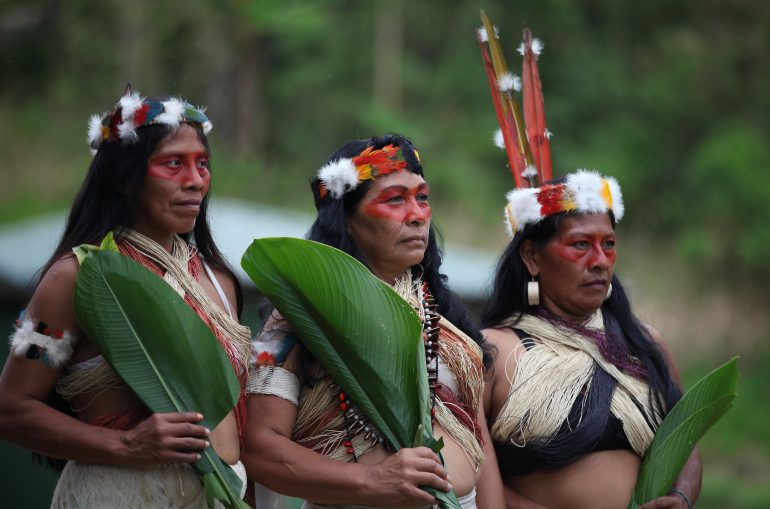
In this context, some significant figures have begun to shown their influence in facilitating change: among others the Bora(1) leader, Liz Chicaje Churay, was awarded with the Franco-German Human Rights Prize and Rule of Law Award for her work in favor of the territorial security of the indigenous communities of Peru(2); Ruth Buendía, Asháninka(3), won The Goldman Environmental Prize (South and Central America) for her leadership skills in raising awareness about the impact of Peruvian energy development and its threats using digital simulations of how the Ene River Valley would be flooded during construction. Today more and more leaders from indigenous communities are involved in environmental defense issues. Another example is Rusbel Casternoque, a leader of the indigenous community Kukama Tarapacà, who is actively fighting for a prior consultation process in the case of “Hidrovia Amazonica”(4), worried about the environmental impacts that would fall on the territory, in particular regarding the issue of food and livelihood sources for communities along the rivers courses there. It should be stressed that among the indigenous peoples we must also not only isolated communities, but those who have integrated into the urban centres or live on reserves (see for example First Nations communities in Canada).

These are many examples of how indigenous cultures are in tension with the industrialized West. With our research we need to raise awareness about the many connections between environmental stewardship and indigenous cultures; at the same time, new technologies and the mass media give a voice and a face to all persons, stimulating proactive processes of change.

In line with this aim, we welcome contributions (in the form of oral sessions, papers, posters, round table sessions or workshop) engaging with any of the following (and associated) topics:

The 21st century indigenous communites and cultural values
Ancestral knowledge and experiential education techniques
Indigenous adaptation measures assisting in current environmental remediation
Tensions between indigenous cultures and globalization processes
Forms of environmental education occurring in Indigenous communities
Modern tools useful for the improvement of life in indigenous communities

Enquiries: staff@weecnetwork.staging.19.coop –  Flavia Napoletano in cooperation with David Zandvliet

References

The World Bank (2018) “Indigenous people”,

Arun Agrawal (2009) Why indigenous knowledge?, 39:4; 157-158, DOI:10.1080/03014220909510569

1Indigenous peoples originally settled in Colombia, nowadays in the north-east of Peru after the rubber exploitation.
2Her actions led the creation of the Yaguas National Park.
3Asháninkas are the demographically largest Amazonian indigenous people of Peru.
4The project involves dredging some areas of the Amazon River (Brazil and Peru) and its tributaries (Marañón, Ucayali and Huallaga), to ensure “safe navigation throughout the year”.

/in Press/di /3 commenti

Next congress in a year. Save money now with the early bird

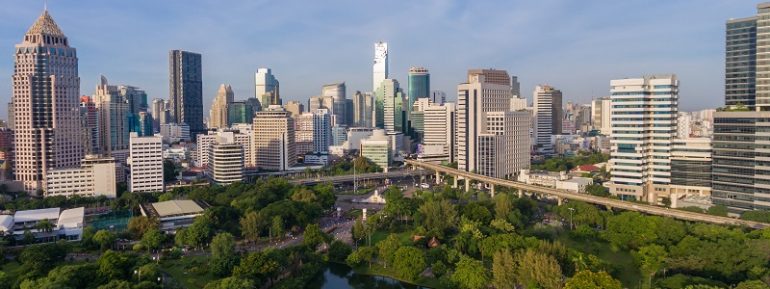
Bangkok Thailand city skyline at central business district of Sathorn street. Drone aerial view. Public park Lumpini in the front.

Until December 31st it is possible to register at 10th Weec, the World Environmental Education Congress, by taking advantage of the special early bird fee.  Do not miss this opportunity to be part of the world’s largest environmental education network and to meet other professionals in the same sector.

Now you can register for the Congress and propose your abstracts.

Stay in touch and save the date! The next Weec Congress will be in Bangkok (Thailand) exactly in a year: 3-7 Novembre 2019.

/in News, Press/di /3 commenti

10th WEEC Call for paper

For the first time the World Environment Education Congresses lands in Asia, in a country like Thailand, rich in history, nature, art and traditions.

It is the Tenth World Environmental Education Congress, an event that we want to celebrate with a congress rich in themes and suggestions.

The title of the 10th WEEC (Local knowledge, communication and global connectivity) refers to the relationship between local knowledge and global connectivity.
On the one hand, local knowledge (based on direct relationship with places, experience, heritage inherited from generation to generation) offers contextualized solutions, technologies appropriate to diversity of situations, sense of belonging, emotional involvement, participation opportunities and concrete action.

On the other hand, humans are linked by a common destiny: they are now connected by thousand powerful channels of communication and are mutually interconnected by the effects of everything that happens on the globe. Continuous exchanges of materials and information are the hallmark of the phase that humanity has come to. More than ever, the classic statement of environmental thought that every local thing is global and vice versa is true.

As always, researchers of all disciplines and all people (individuals and organizations, public and private) operating in some way in environmental knowledge and values are invited to participate in the 10th WEEC: academics, teachers, journalists, science disseminators, practitioners, operators of parks, museums, eco-museums, local authorities, associations, etc., because the environment is transversal to every aspect of human knowledge and involves deeply attitudes, behaviors and reflexive critical action at all ages and in every aspect of personal and social life .

Presentations can be used to describe and / or discuss and comment on theoretical positions, researches, criticalities, educational challenges, methods, good/best practices, and educational tools.

Presentations may have different formats, but all of them will obviously have a reference to the educational aspects and sub-themes listed here.

Of course, each group of participants will be maybe fascinated by specific paths through the themes. For example:

1. Teachers and trainers, interested in their work in schools, will focus on Methods and Science about Teaching and Learning EE and sustainability education.

2. NGO’s and civil society will be engaged and interested in change towards a sustainable society, in cooperation for EE and sustainability education, in experiences, outcomes, educational challenges.

3. Politics and media in bringing international contracted goals into reality, and systemic work in politics and media.

4. Vulnerable groups and the call for Eco-justice will focus on strategies, experiences, challenges and solutions for change.

The organisers of the 10th WEEC 2019 would like to stress that the sub-themes are suggestions and not watertight compartments or sealed boxes. So, interaction and cross-disciplinary papers and discussion amongst the delegates will be encouraged.

SUB-THEMES

Section 1: Local Sphere

Theme 1: Understanding and social use of science: science-society-technology-environment and participation.

Theme 2: Ageing Society and sustainability.

Theme 3: Sufficiency Economy for sustainability, sustainable consumption and lifestyles.

Theme 4: Waste and Pollution Management through Environmental Education.

Theme 5: Learning based on sustainable and solidary agriculture.

Theme 6: Disaster Preparedness, Climate change adaptation and mitigation.

Theme 8: Natural Resources and Livelihood.

Theme 9: Research, Design and Innovation.

Theme 10: Eco-citizenship, democracy and mobilization: participatory processes and citizen’s involvement in democratic decision-making processes.

Theme 11: Stakeholders in dialogue: educating public and private organisations for a common task.

Section 2: Environmental Education and Communication Sphere

Theme 11: Science Communication and Social Media.

Theme 12: Interpretation of Science and the Environment.

Theme 13: Environmental Education Programs: Non-Formal Education.

Theme 14: Environmental Ethics, Philosophy and Culture.

Theme 15: The political dimension of Environmental Education.

Theme 16: Environmental Promotion and Networking.

Theme 17: Digital Technology Learning and Environmental Education.

Theme 18: Early Childhood Education and Environmental Education.

Theme 19: Environmental/Sustainability Education, Teachers education and Methodologies for a really effective, empowering, and transformative education.

Section 3: Global Connectivity Sphere

Theme 20: World Green Remediation: education as crucial tool for social, environmental and climate justice and equity in a greener society.

Theme 21: “Common good” and future well-being without poverty.

Theme 22: Urban Ecosystem and Sustainability.

Theme 23: Health, risks and safety, and food sustainability.

Theme 24: Gender Equality, Environmental Education and Sustainability.

Theme 25: Educational policies between renewal and not honoured commitments.

Theme 26: Global Challenge and Policy.

Theme 27: Community and Global Responsibility.

Theme 28: Consciousness and Ecological Tourism.

Theme 29: Peace as a socio-ecological issue.

Submit your abstract here
/in News, Press/di /Lascia un commento

WEEC2019, discovering the themes

The title of the 10th WEEC (Local Knowledge, Communication and Global Connectivity) refers to the relationship between local knowledge and global connectivity.

On the one hand, local knowledge (based on direct relationship with places, experience, heritage inherited from generation to generation) offers contextualized solutions, technologies appropriate to diversity of situations, sense of belonging, emotional involvement, participation opportunities and concrete action.

On the other hand, humans are linked by a common destiny: they are now connected by thousand powerful channels of communication and are mutually interconnected by the effects of everything that happens on the globe. Continuous exchanges of materials and information are the hallmark of the phase that humanity has come to. More than ever, the classic statement of environmental thought that every local thing is global and vice versa is true.

As always, along with the title theme of the congress, various other arguments relevant to environmental education, divided into 8 thematic niches, will be dealt with.

1.Water for Life, Marine Ecology and Conservation, Ecological Services and Biodiversity
2.Food Security and Sustainable Agriculture
3.Air Pollution and Atmospheric Education, Climate Change and Disaster Preparedness
4.Sustainable Energy for All
5.Green Industry, Social Responsibility and Economics Balancing
6.Waste Management, Green Innovation and Urban and Environmental Society
7.Sustainable Life Style and Human Well-Being, Environmental Promotion and Communication
8.Arts, Lifelong Learning in Environment, Global Challenge and Networking

/in News, Press/di /3 commenti

WEEC 2019, the call for paper coming soon

In a few days the call for paper for the Weec 2019 will be open.  It is time to start thinking about what to present during the tenth edition of the World Envirionmental Education Congress that will be held in Bangkok, Tahiland in November 2019, just over a year from now.

The presentation formats are: oral an posters presentation, round tables sessions and workshops.
During the NGOs Forum the organisations will present their programs, projects, and productions. A space with a table will be offered to each NGO for a three hour period, where presenters will interact with Congress participants.