Tag Archive for: COP28

/in News, Press/di /Lascia un commento

Leveraging COP 28 consensus for inclusive socio-environmental transformation

Brazil and paths after COP 28

by Dra. Vanessa Sousa de Oliveira, Dr. Marcos Vinicius Campelo Junior

Between November 30 and December 12, 2023, the 28th Session of the Conference of the Parties (COP 28) of the United Nations Framework Convention on Climate Change (UNFCCC) took place in Dubai, United Arab Emirates. The 195 participating countries discussed strategies to reduce, mitigate, and control the emission of greenhouse gases, responsible for climate change.

The Conference of the Parties (COPs) is the most important international meetings to discuss climate change. The United Nations Framework Convention on Climate Change (UNFCCC) agreement establishes commitments and obligations for the signatory countries, where strategies to curb the acceleration of climate change are discussed and negotiated.

The final document of COP 28 can be analyzed from different perspectives. When assessing global responses to climate change, the goal of uniting efforts to ensure the stabilization of the planet’s warming at 1.5°C, as defined in the Paris Agreement, identified significant omissions in the commitments made, especially by developed countries. The existing advancements were considered timid and disjointed.

For the first time, the overall balance of the Paris Agreement explicitly addresses the reduction of production and consumption of fossil fuels, ensuring global consensus on an energy transition and assigning greater responsibility to developed countries. However, the reduction values and funding sources for decarbonization of energy systems were not defined.

Another achievement is the connection with the Convention on Biological Diversity (CBD) through issues directly related to the conservation of biodiversity, its sustainable use, and the fair and equitable sharing of genetic resources in the three levels categorized in the CBD: ecosystems, species, and genetic resources.

In its participation, Brazil focused on mediating consensus between developed countries and those that can develop in setting goals and fulfilling them in addressing climate change. It is certain that to achieve environmental justice, one must consider the historical gap between rich and poor nations. Proportionally, nations with greater economic power must initiate the process of abandoning fossil fuels, thinking about decarbonization within the set goals.

Given Brazil’s socio-environmental importance on the international stage and anticipating its role as the host country for COP 30 in Belém do Pará (PA) in the heart of the Brazilian Amazon in 2030, how can Brazil use the current established consensus to strengthen its actions domestically and present itself as a leader in the global environmental context with internal proposals that go beyond reducing deforestation in the Amazon Rainforest?

Brazil, as a strategic environmental actor, plays an important role in this context and can contribute with successful experiences and new models of socio-environmental management. These biomes present a significant representation of sociobiodiversity: forests, wildlife, and the presence of people who inhabit these spaces, such as quilombolas, indigenous peoples, riparian dwellers, rubber tappers, and others.

We believe that Brazil’s significant contribution to the international decarbonization process lies in public policies focused on resolving internal conflicts that directly affect the existence of indigenous and traditional peoples, as well as the quality of life in urban centers. Reducing socio-environmental inequalities, ensuring fundamental rights, and protecting biomes that are directly related.

Ensuring the legal protection of indigenous and quilombola lands and their way of life integrated with nature; Expediting agrarian reform, which constitutionally revolves around the social use of land. Expanding successful experiences of sustainable agriculture and livestock farming carried out by social movements in rural areas; Incorporating clean technologies produced in universities into urban mobility structures, construction, and educational processes for new generations.

Finally, it will be necessary to unite governments, civil society, researchers, and others in this endeavor, which may be our last chance to “postpone the end of the world” (a reference to the title of Ailton Krenak’s book). Thus, social justice, climate justice, and the reduction of inequalities form an inseparable triad that will underpin the processes of economic, social, and symbolic decarbonization. Above all, we need to decarbonize our thinking!

/in Press/di /Lascia un commento

Integrating artificial intelligence in global environmental education: insights from COP28 and prospects at WEEC12

The recent COP28 held in Dubai has raised concerns within the environmental education community due to the absence of the term “education” in the discussions and strategies outlined. It is crucial that the concept of education be meaningfully integrated into global climate strategies, and the opportunity to do so presents itself tangibly at the 12th World Congress on Environmental Education (WEEC12) to be held in Abu Dhabi.

In particular, special attention is sought for the use of Artificial Intelligence (AI) in the field of environmental education. The transformative potential of this technology in enhancing the effectiveness of global climate education is clearly evident. Events related to COP28 have preluded this discourse, highlighting the fundamental and innovative role of AI in making sustainability approaches accessible and engaging.

The debates arising from events connected to COP28 clearly demonstrate that AI can play a crucial role in making environmental knowledge more widespread and engaging. Collaboration between environmental education experts and technology developers can contribute to the development of innovative educational tools and resources that fully leverage the potential of AI.

WEEC12 represents a unique opportunity to place the central role of environmental education on the agenda, with a specific emphasis on the integration of Artificial Intelligence. Addressing this issue proactively and collaboratively could shape a more sustainable future, where environmental knowledge becomes a driving force in the global fight against climate change.

Join our network and become part of the conversation on COP28! Send your contributions to secretariat@weecnetwork.staging.19.coop and help shape the environmental dialogue.

COP28 reminds us all of the urgency to attend WEEC12 in Abu Dhabi!

by Dr. Costis Toregas, The George Washington University

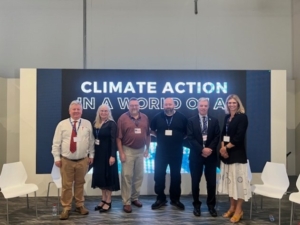
Left – right: Gerry Cunningham (EAGLES 2030) , Pat Cummens (Esri), Sean Breyer (Esri), Lee Mallon (Humanity), Erwin Rose (US State Dept), Valerie Hawley (Sorbonne Univ.)

The text that emerged from the lengthy discussions during COP28 just concluded in Dubai was hotly debated, and engaged the participants in difficult discussions of what language to include and which to exclude… and for some in the Environmental Education (EE) community, it rang a warning bell!  A quick key word search revealed that the word “Education” did not appear even once!  Of course no one will argue that education should be part of any global solution to climate change and the challenges of sustainability.  However, the modalities and strategies that will bring education as a supporting platform to the vital COP28 action verbs of Finance, Capacity Building and Technology Transfer must be rapidly deployed, discussed and agreed upon by relevant stakeholders.

And what a better place to do so than at WEEC12 in Abu Dhabi on January 29 through February 2, 2024!

To align the education agenda to the Technology Transfer actions, we can focus on the use of Artificial Intelligence (AI) in Environmental Education (EE), catalysing climate action  and contributing to environmental education.  In recent years the role of artificial intelligence (AI) has gained significant attention across the environmental and academic community.  The world is facing the triple planetary crisis – climate change, biodiversity loss and pollution – and technology and innovation has a key role to play in addressing these challenges.  There is an urgent need for innovative solutions to educate and engage the public in sustainable practices. This pathway will be amply demonstrated at WEEC12, with three sessions dedicated to the role of AI in enhancing the effectiveness of environmental education irrespective of geographic location, language barriers or technical infrastructural constraints.

To foreshadow these panels and underline the importance of EE, there were events at COP28 that addressed AI’s role in promoting new ways and tools for educators.

“AI is emerging as a powerful tool for how we learn about and interact with the environment, particularly through repackaging information and enhancing personalized learning experiences” said AI expert Lee Mallon, CTO of Humanity, Abu Dhabi at a COP28 side event on AI (see photo).  “Artificial Intelligence possesses the remarkable capability to transform extensive, 100-page reports on positive climate action into finely detailed narratives. This approach ensures that every individual across the globe can grasp the necessary steps for climate action. It tailors the information to align with the media channels that resonate most effectively with each person, enhancing their understanding and engagement in impactful environmental action”.

Other participants in the side event included US representative Erwin Rose who laid out a clear path for AI’s introduction as a powerful tool to support sustainability through the Climate Technology Centre and Network, eSRI representatives detailing location-based AI advances and EAGLES2030 chair Gerry Cunningham who offered practical strategies for implementation through collaboration.